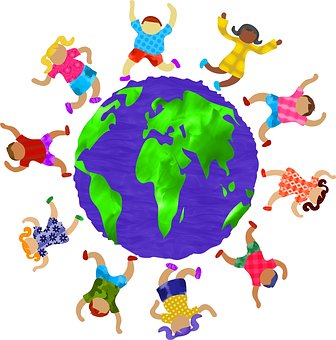
What does it mean for children to feel different?

When do children notice that they are different from other children? Is it when they see someone wearing something they would like to wear? Is it when they see someone playing with a toy they would like to have? Is it when they see the educator being very attentive to a parent that is not theirs? Is it when they see someone eating something they would like to have? Is it when they learned colours and realised that their skin colour is different than the skin of other children?

Children learn to make judgments about who they are at a very young age. They have also developed ideas about others around them.

The Doll Test:

As an example, the “Doll Test” examined children’s attitudes towards race and found that most children are aware of racial stereotypes. The Doll Test is available at:https://www.youtube.com/watch?v=tkpUyB2xgTM

The Adults’ Role:

Children need support as they are making sense of their social environment. Parents and educators are expected to initiate those discussions. So, when is the appropriate time for adults to discuss development including race and non-race-related social development with children?

One study examined the developmental readiness of children to understand behaviours and traits and compared the scientific findings with the estimates that adults thought were appropriate times to approach those topics with children.

Specifically, the study examined participants’ estimates of the age at which children develop race-related awareness, non-race related social development, and non-social development. The participants were also asked when they would start discussing race with children. Participants were from the USA and half of them were parents. The results were compared to the ages children were scientifically found to start developing those types of awareness.

Developmental Findings:

Developmentally speaking, children are able to:

  1. Prefer people based on their race by three months of age.
  2. Categorise faces based on race from 9 months.
  3. Associate face colour (or race) with positive or negative traits based on the messages they receive from their environment by the third year of age.
  4. Associate racial groups with wealth or power by the fourth year of age.   

The Educator’s Role:

What should the educator pay attention to in a classroom especially when it comes to children who are different or who are minority?

Educators should start by questioning their own values and beliefs about how children learn and their role in ensuring children’s future success.

Educators need to implement a curriculum that allows for equitable opportunities with no bias.

For additional information, please refer to the following article and related supplement:

Sullivan, J., Wilton, L., & Apfelbaum, E. P. (2020, August 6). Adults delay conversations about race because they underestimate children’s processing of race. Journal of Experimental Psychology: General. Advance online publication. http://dx.doi.org/10.1037/xge0000851

How do infants and toddlers socialize?

The infant learns what it means to socialize by interacting with family members and by engaging in activities with them.

Early on, the infant reacts to the adult’s smile and gestures by smiling back, by moving, or by vocalizing sounds. With time, the child not only reacts but also initiates social encounters even when the basic needs are taken care of.

For the socialization process to be successful, the infant needs to feel that the context is secure and safe to explore, to express own emotions, and to expect a positive response. The mother or caregiver provides the child with the emotional and physical supports to explore the surroundings thus facilitating the baby’s feeling that the world is safe to explore. Babies understand that they could refer back to the adult, if needed.

Babies experiment with their responses. By the second year, the gestures become more accurate. For example, toddlers would wave Goodbye to a person leaving. They also start to use different intonations of language for different social purposes. They learn to say “no” to assert their choices and to test how far they can get away not doing as told.

By the third year, toddlers get a refined sense of the adults’ thoughts and feelings. This skill strengthens their ability to know when it is better to respond to the adults’ requests and what could be negotiated. Toddlers are seeking to develop autonomy and independence as they go about exploring the world.

Infants and toddlers learn valuable social skills when they have siblings. As children can have different set of skills, they engage and negotiate with varying strengths. So, the rules of social play get constantly redefined. This is quite different than the interaction with the adult who models interactions with the infant in a more predictable manner.

Children who attend day care at an early age will have different levels of acceptance to the setting. This is dependent on their temperament, home interactions, and the characteristics of the caring environment. High quality service delivery ensures that the child is receiving adequate attention from a caregiver.

Peers provide social support for the toddler when there is consistency in the implementation of the rules. Parallel play is often the form where a child first engages in social interactions with another child. It starts with the children playing in close proximity to each other. This is followed by each child keeping an eye on what the other child is doing without necessarily engaging in play or initiating a verbal communication.

Children observe other peers and could imitate them. Role play is a powerful medium for children to practice the skills that they observed. This capacity will become more enhanced by 3 years of age.

As children grow older, they will engage in group play and will apply rules of successful interactions. From there begins a lifelong process of socializing that will take them to different people, places, and cultures. They will engage in a global world and develop the tools to successfully do so.

Reference:

Garvis, S., Phillipson, S., Clarke, S., Harrison, L., McCormack, J., & Pendergast, D. (2019). Child development and learning. Oxford University Press.


BACK TO Global Education Posts


BACK TO Early Childhood Development Posts


HOME