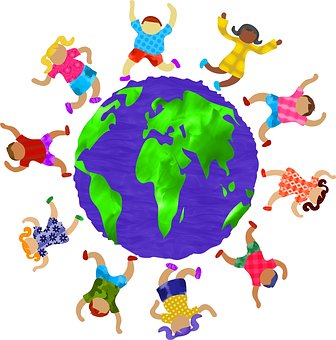
What does it mean for children to feel different?

When do children notice that they are different from other children? Is it when they see someone wearing something they would like to wear? Is it when they see someone playing with a toy they would like to have? Is it when they see the educator being very attentive to a parent that is not theirs? Is it when they see someone eating something they would like to have? Is it when they learned colours and realised that their skin colour is different than the skin of other children?

Children learn to make judgments about who they are at a very young age. They have also developed ideas about others around them.

The Doll Test:

As an example, the “Doll Test” examined children’s attitudes towards race and found that most children are aware of racial stereotypes. The Doll Test is available at:https://www.youtube.com/watch?v=tkpUyB2xgTM

The Adults’ Role:

Children need support as they are making sense of their social environment. Parents and educators are expected to initiate those discussions. So, when is the appropriate time for adults to discuss development including race and non-race-related social development with children?

One study examined the developmental readiness of children to understand behaviours and traits and compared the scientific findings with the estimates that adults thought were appropriate times to approach those topics with children.

Specifically, the study examined participants’ estimates of the age at which children develop race-related awareness, non-race related social development, and non-social development. The participants were also asked when they would start discussing race with children. Participants were from the USA and half of them were parents. The results were compared to the ages children were scientifically found to start developing those types of awareness.

Developmental Findings:

Developmentally speaking, children are able to:

  1. Prefer people based on their race by three months of age.
  2. Categorise faces based on race from 9 months.
  3. Associate face colour (or race) with positive or negative traits based on the messages they receive from their environment by the third year of age.
  4. Associate racial groups with wealth or power by the fourth year of age.   

The Educator’s Role:

What should the educator pay attention to in a classroom especially when it comes to children who are different or who are minority?

Educators should start by questioning their own values and beliefs about how children learn and their role in ensuring children’s future success.

Educators need to implement a curriculum that allows for equitable opportunities with no bias.

For additional information, please refer to the following article and related supplement:

Sullivan, J., Wilton, L., & Apfelbaum, E. P. (2020, August 6). Adults delay conversations about race because they underestimate children’s processing of race. Journal of Experimental Psychology: General. Advance online publication. http://dx.doi.org/10.1037/xge0000851

How can schools stop bullying and what could children do?

Bullies target a person with the intent of harming physically, emotionally, or socially. Bullying is rarely innocent and happens for a variety of reasons. The presence of the bullied person is not welcome and he/she must pay for being different and is made to feel that he/she will not belong easily if at all.

Bully Stoppers is an online resource that includes learning modules and advice sheets to help students, parents, teachers, and principles address and prevent bullying. The following is drawn from that reference.

Children who are bullied could do any of the following:

  • Tell someone they trust and write down the actions with dates and times.
  • Ask for help: Targeted children need to ask for advice on how to address the issue.
  • Confront the bully(ies) confidently if it is safe to do so alone or ask a friend to accompany them.
  • Think of the people who love and support them and draw strength from this.
  • Accept that we should not please people at the expense of what we like, who we are, or what is better for us.
  • Avoid being intimidated by the bullies by ignoring them.
  • Not internalise the negative outcomes intended by the bullies and understand that it is not their fault that they are targeted.
  • Avoid retaliating from the bully(ies) as this tactic rarely works.
  • Engage in activities in and outside school that help develop fulfilment and positive self-worth.
  • Befriend children who are supportive.

Unfortunately, the topic is rarely resolved on its own. Schools have an important role to play in building healthy social networks on the school grounds so children grow up to become successful members of their societies and the world. Teachers and principals need to be part of the solution by establishing anti-bullying programs in schools. Empowering each child is the first step.

Reference:

State Government of Victoria. Department of Education and Training. (2019). I’m being bullied. Retrieved from  https://www.education.vic.gov.au/school/students/health/Pages/studentbullied.aspx

HOME

The “Doll Test” and teaching respect in early childhood

Children learn to make judgments about who they are at a very young age. They have also developed ideas about different groups. The Doll Test examined children’s attitudes towards race and found that most children have practised and internalised racism.

The Doll Test is available at:

https://www.youtube.com/watch?v=tkpUyB2xgTM

An Italian version of the Doll Test experiment is available at:

https://www.youtube.com/watch?v=QRZPw-9sJtQ

In one study around Difference, Diversity, and Human Dignity (the Three Ds), a team of researchers used story time to discuss children’s emerging understandings of skin color, race, ethnicity, disability, self-worth, poverty, and gender. They analysed 36 videotaped story sessions and found that children’ negative attitudes towards the Three Ds changed. Children became more inclusive in their language and behaviour as a result of discussing the stories.

Teaching for social justice is important in early childhood in order to help children develop to their full potential and to be active members in a global world.

Reference:

Hawkins, K. (2014). Teaching for social justice, social responsibility and social inclusion: A respectful pedagogy for twenty-first century early childhood education. European Early Childhood Education Research Journal, 22(5), 723-738. doi:10.1080/1350293X

HOME