
Labelling Body and Facial Expressions

Labelling Emotions

Children use body and facial expressions to reflect their emotions. By the same token, children need to interpret body and facial expressions as part of their emotional development.

Children who cannot express their needs could get frustrated or miss out on engaging in activities with other children. One example is a child who is too shy to ask peers to play with them. Another example is a child who is trying to get a toy or a game from someone else. In both examples, children need to be able to express what they want and understand the feedback of other children whether verbal or non-verbal.

Role of educators:

How can educators help children enrich their emotional vocabulary and enhance their communication skills in order to successfully negotiate what they want?

Educators need to provide activities that help children recognise emotions such as anger, sadness, surprise, happiness, and frustration in themselves and other children. A child who can recognise the intentions of other children by correctly reading their emotional expressions will have a better chance of being included in any setting.

Expressing and interpreting emotions are pathways to emotional regulation and successful socialisation.

Building a vocabulary of emotions from simple to complex ones is part of children’s socio-emotional development. According to Plutchik’s wheel of emotions (Six Seconds, n.d.), the basic emotions are joy, disgust, anger, and anticipation, and their opposites are sadness, trust, fear, and surprise respectively. The combination of two basic emotions brings up a new emotion.

Children need concrete activities to interpret and label emotions. Educators could teach children how to recognise the affective states of other children by looking for their body language, facial expressions, and tone of voice.

A simple activity of having a face with a printed emotional label could be a starting point.

Reading children’s books to children can contribute to their understanding of affective states. Often, in children’s books, the plot revolves around an issue that triggers an affective state and how to resolve the issue.

Games could be used as well. One example is asking children to play musical chairs. On each chair, there is a card of a facial expression flipped face down. When the music stops and the children sit down, they are asked to turn the card over and explain what emotion the face is expressing. They are also asked to make the same face. The children are then asked to go for a second round and repeat the process and so on. This allows the children to experiment with facial expressions in a non-threatening environment. More complex emotions could be introduced as children learn the basic ones.

The Georgetown University Center for Child and Human Development (n.d.) proposed other ideas. The educator could:

  • Provide activities that help children label their emotions. For example, they could look at the mirror and make faces and then try to label the emotion.
  • Read a book to the children and ask them to guess how the child is feeling based on the text or based on the illustrations.
  • Ask children during “show and tell” to make a facial or a body expression about how the activity they are sharing made them feel.
  • Assist children in making up a song about activities or actions that make them feel happy, sad, angry, surprised, and so on. The words of a familiar song could be adapted.
  • Provide props for children to role-play different experiences in the dramatic area. An example is going to see the doctor and trying to act the experience out.
  • Prepare cards of activities and facial expressions and ask children to pair the activity with the facial emotion it brings in them.
  • Play a game with children where one child chooses a card that has an expressed facial emotion and imitates that emotion. The other children must guess the emotion.
  • Prompt children to come up with a solution for a child who is sad, angry, or unhappy about an event through problem-solving.

Why are interpreting and labelling emotions useful?

Joseph and Strain (2003) elaborated on the process. When children recognise and label their feelings, they develop emotional regulation and when they recognise and label other people’s emotions, they strengthen their problem-solving skills. The process then assists the children to come up with solutions acceptable to themselves and other parties thus generating a win-win outcome.

The educators could easily share the information with parents. Both parents and educators could scaffold children as they navigate the emotional realm around them. A synchronized process would support children as they grow up in a global world.

References:

Georgetown University Center for Child and Human Development. (n.d.). Ideas for teaching about emotions. https://www.ecmhc.org/ideas/emotions.html  

Six Seconds. (n.d.). Plutchik’s wheel of emotions: Exploring the emotion wheel. https://www.6seconds.org/2022/03/13/plutchik-wheel-emotions/

Joseph, G. E., & Strain, P. S. (2003). Enhancing emotional vocabulary in young children. Young Exceptional Children, 6(4), 18-26.  https://journals.sagepub.com/doi/pdf/10.1177/109625060300600403
What does it mean for children to feel different?

When do children notice that they are different from other children? Is it when they see someone wearing something they would like to wear? Is it when they see someone playing with a toy they would like to have? Is it when they see the educator being very attentive to a parent that is not theirs? Is it when they see someone eating something they would like to have? Is it when they learned colours and realised that their skin colour is different than the skin of other children?

Children learn to make judgments about who they are at a very young age. They have also developed ideas about others around them.

The Doll Test:

As an example, the “Doll Test” examined children’s attitudes towards race and found that most children are aware of racial stereotypes. The Doll Test is available at:https://www.youtube.com/watch?v=tkpUyB2xgTM

The Adults’ Role:

Children need support as they are making sense of their social environment. Parents and educators are expected to initiate those discussions. So, when is the appropriate time for adults to discuss development including race and non-race-related social development with children?

One study examined the developmental readiness of children to understand behaviours and traits and compared the scientific findings with the estimates that adults thought were appropriate times to approach those topics with children.

Specifically, the study examined participants’ estimates of the age at which children develop race-related awareness, non-race related social development, and non-social development. The participants were also asked when they would start discussing race with children. Participants were from the USA and half of them were parents. The results were compared to the ages children were scientifically found to start developing those types of awareness.

Developmental Findings:

Developmentally speaking, children are able to:

  1. Prefer people based on their race by three months of age.
  2. Categorise faces based on race from 9 months.
  3. Associate face colour (or race) with positive or negative traits based on the messages they receive from their environment by the third year of age.
  4. Associate racial groups with wealth or power by the fourth year of age.   

The Educator’s Role:

What should the educator pay attention to in a classroom especially when it comes to children who are different or who are minority?

Educators should start by questioning their own values and beliefs about how children learn and their role in ensuring children’s future success.

Educators need to implement a curriculum that allows for equitable opportunities with no bias.

For additional information, please refer to the following article and related supplement:

Sullivan, J., Wilton, L., & Apfelbaum, E. P. (2020, August 6). Adults delay conversations about race because they underestimate children’s processing of race. Journal of Experimental Psychology: General. Advance online publication. http://dx.doi.org/10.1037/xge0000851

How to help a child sleep better?

People go through 4 to 5 cycles of sleep per night with each cycle extending from 75 to 90 minutes. The cycle includes two main states, the Non Rapid Eye Movement (NREM) state and the REM sleep. The REM sleep is the last stage in the cycle and it is the stage where we dream.

It is important to go through REM and NREM to get the full benefits of sleep. Those include better memory, increased creative thinking abilities, and enhanced pathways between the left and right sides of the brain.

When we sleep, the body evaluates the information acquired during the day and decides what to keep for later use and what to discard. Storing the information in long term memory allows us to build on this experience to better sort out related issues. The process itself strengthens the neural connections in the brain.

What goes on before sleep plays a role in sorting out problems as well. One study found that thinking about a question before going to be induced dreams regarding the issue for half the participants and solutions for a quarter of them.

Sleepiness builds up during the day and is released when we sleep. If we don’t get enough sleep, we feel unable to make decisions that require a lot of focus. We are also prone to making mistakes in judgment due to a lack of full attention.

It is important to maintain consistent sleep routines, avoid using the computer the last hour before sleep, have the last heavy meal for the day at least 3 hours before sleep, and sleep in a dark and cool room.

Some children have issues going to bed and keep waking up through the night. The attached video covers states of sleep and factors related to sleep problems including if the child is a morning or an evening person. The video also includes ideas on what parents and educators could do to help the child sleep better.

For additional information, refer to:

Karman, M. (2023, July 15). How sleep improves and impairs creative thinking. Eachnight. https://eachnight.com/sleep/sleep-improves-impairs-creative-thinking/ .

Rethinking the NO in Guiding Children’s Behaviour

Have you ever asked yourself as a parent or as an educator why do you say NO when a child asks for something?

Rethinking the NO brings us to a journey inside ourselves where we need to be clear about our beliefs, values, and daily responses.

Firstly, with regards to beliefs, we need to consider the following: If we believe that children need guidance all the way through and that they are not able to take good decisions, this will make us react differently to children’s requests than if we believe that children want guidance to make the right decision themselves.

Giving guidance highlights that children have needs that they like to see fulfilled and are happy to learn from the people around them so there is a win win situation between the adult and the child.

A belief that children learn when adults enforce strong rules early on in life triggers a strict and firm response from the adult with little room for flexibility. The emphasis is on exerting an effort to prevent the child being spoiled.

What are your beliefs as a parent or as an educator?

Secondly, what are our values?

If we value respect from the child to the parent by all means, we don’t mind if the child fears us. We should be controlling and demand respect from the child regardless even if the respect is not in the child’s best interest.

On the other hand, if we value the rights of children to meet their needs, we respect this right and guide them towards fulfilling their needs in socially acceptable manner even if that means that the child could grow up different than us, the parent or the educator, and could be interested in different activities.

We have to be careful when we ask children to comply with our demands without any consideration for their opinion. This teaches them that the strong person should be followed and they could later follow an abuser out of fear and of a need to belong.

We want to gradually give the children control over their decisions and to release our power. More importantly, we want to be compassionate towards children. They make mistakes but that does not mean that they have evil intentions.

The ideal practice is to acknowledge the behaviour or misbehaviour that children engage in without defining the personality of the child based on that behaviour. We need to accept that children need to learn how to present their beliefs, values, and practices, and that there will be many attempts along the way prior to working out what conveys the need and the message and what doesn’t.

We want children to have a bank of constructive activities and behaviours instead of constantly reminding them of what is not working.

That is how we can help children grow into successful global citizens ready to explore and contribute to the future of humanity.

For further reading, refer to:

Porter, L. (2016). Guiding children’s behaviours. In M. Ebbeck, & M. Maniganayake (Eds.), Play in early childhood education: Learning in diverse contexts (2nd ed., pp. 161-182). Oxford University Press.

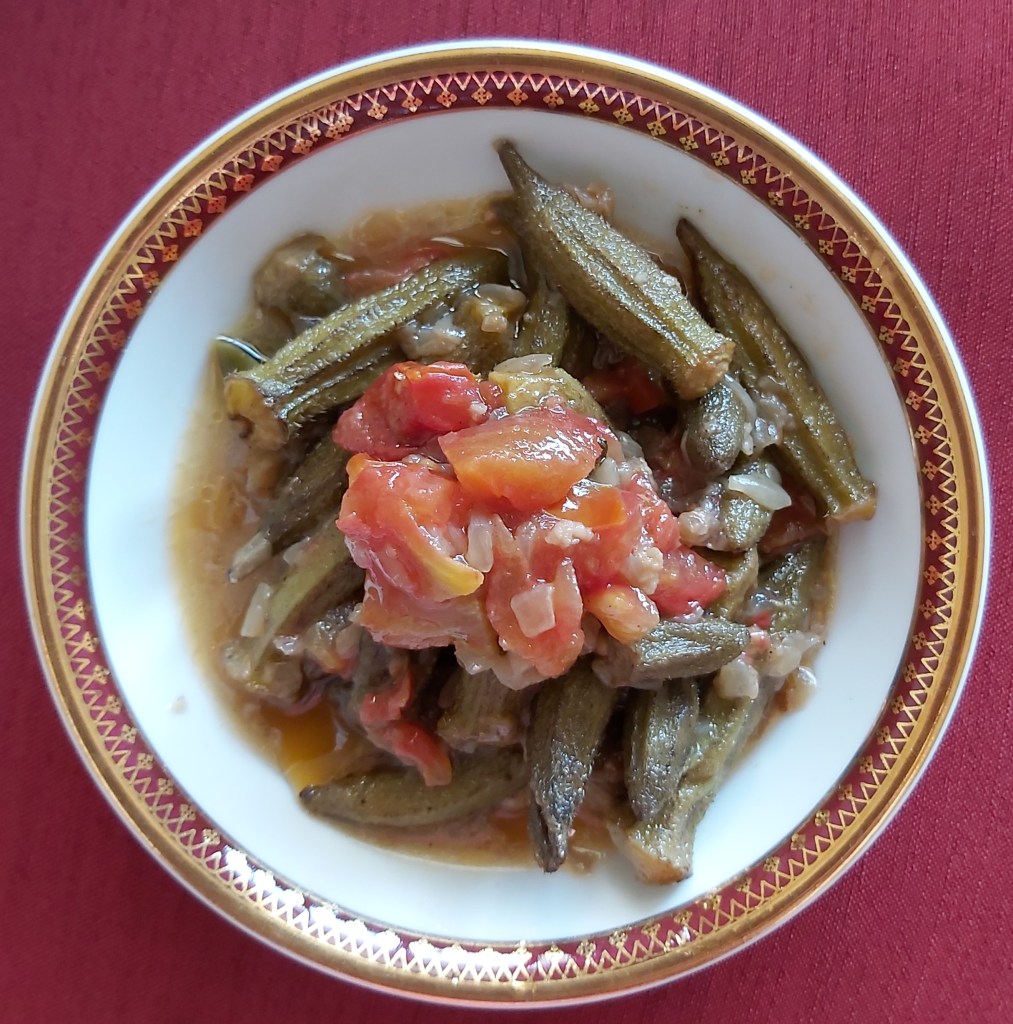
Bamieh BiZeit – Okra with Olive Oil (Lebanese Recipe)

by MAJIDA MEHANA

The following family recipe is a delicious and easy method to prepare the vegetarian dish of Okra with Olive Oil (Bamieh BiZeit).

Ingredients:

Okra: Half a Kilogram.

Onion: 1 large size onion diced into small pieces.

Pepper: One sweet pepper diced into small pieces.

Tomatoes: 5 diced medium sized tomatoes.

Garlic: Four to five ground cloves.

Salt: Half a teaspoon, add to taste.

Water: 150 to 200 ml.

Olive oil: Two spoons, add to taste.

Vegetable oil.

Spices: A pinch of cinnamon and 7 spices (see note below). If not available, add black pepper and paprika to taste. A quarter to half a teaspoon.

Serving: Add to taste:

  • Pita bread.
  • Green onions, continental mint, olives, radish, and yogurt at the side.
  • Seven spice mix, black pepper, and/or cumin. The “seven spice mix” is common in stores that sell Lebanese food or Middle Eastern products. The Lebanese seven spice mix can change from a store to another. In general, it is a mix of black pepper, cumin, paprika, coriander, clove, nutmeg, and cinnamon.

Preparing the okra:
The okra should be soft and small. Remove a part of the head by cutting in a circular motion leaving a small tip. Do not cut into the pod. Wash quickly and dry well in a strainer.

Steps:   

  • Fry the okra in vegetable oil.
  • In a second pan, fry the diced onion on medium heat using a mix of olive oil and another vegetable oil. Have enough oil to just cover the onions.
  • After couple minutes, add the pepper, garlic, salt, and spices. If the 7 spices mix is not available, add paprika and black pepper.
  • Stir the mix until the onions start to become yellow and cooked.
  • Add the diced tomatoes to the mix, taste and add more salt and spices as needed.
  • Heat 150 to 200 ml of water separately.
  • Add the okra and water to the mix.
  • Cover and simmer on low to medium heat for around 15 minutes.

Serving:

  • The dish is served cold with pita bread, green onions, continental mint, olives, and/or radish.
  • Yogurt can also be added at the side.

The dish is served at lunch with bread. Often, Okra is cooked with meat when served with rice. People who are vegetarian might like to have it with rice as well.

Enjoy!

BACK TO GLOBAL FOOD PAGE

BACK TO FUTURE GLOBAL CHILDREN HOMEPAGE

HOME

How to build success?

When children are learning to walk, they fall and get up time after time until they learn. They don’t make a decision to stop trying and to crawl for the rest of their lives.

They are not concerned about how much time it is going to take to get what they want. They don’t know much about time or the future. That seems to work for them. They are willing to give tasks the required time to achieve them. They live in the moment.

They might not be happy repeating all over but that does not stop them. They are not forcing happiness or positive thinking upon themselves.

Do children’s responses differ? Yes, they do. They might accept difficulties with ease but also may not. Babies process their feelings by crying. It is their way to express themselves and to sort things out. Crying does not stop them. It might even encourage to persist.

Children are patient most of the times. Sometimes they get frustrated. Does either of those two feelings stop them from trying again? The answer is “No”.

Yes, they would like approval from people around them but not at the expense of doing what that they really want to do.

How to build success? Adults need to allow children to solve their problems on their own. Children are natural explorers. They experiment and accept that things might not work out right away.

Can we as adults solve our problems as children do, please?

BACK TO Global Education Posts

BACK TO “EARLY CHILDHOOD DEVELOPMENT” POSTS

BACK TO Early Childhood Development Posts

BACK TO “FUTURE GLOBAL CHILDREN” HOMEPAGE

HOME

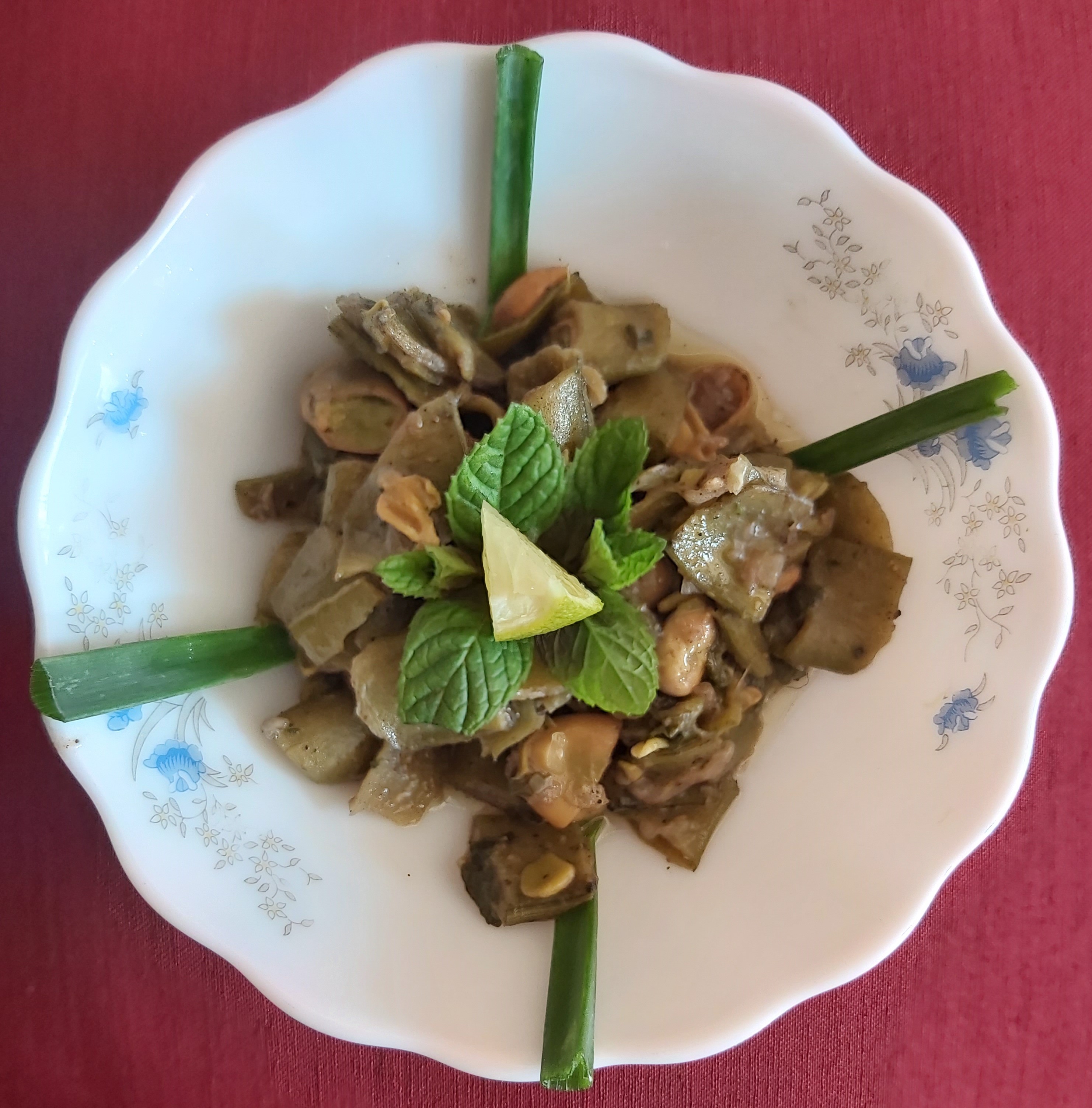
Foul Akhdar BiZeit – Green Fava Beans (Lebanese Recipe)

by MAJIDA MEHANA

Green Fava Beans

The following family recipe is a delicious and easy method to prepare the vegetarian dish of Green Fava Beans (Foul Akhdar BiZeit).

Ingredients:

Green Fava Bean pods: 1 Kilogram.

Onions: 2 Medium onions diced into small pieces.

Green onions: 6 green onions washed and cut into small pieces.

Vegetable Oil.

Olive oil: Three to four spoons, add to taste.

Garlic: One ground clove. Could add more or not use at all.

Fresh coriander/cilantro leaves: Half a bunch washed and chopped in fine pieces. Discard the stems.

Salt: Half a teaspoon. Add to taste.

Serving: Add to taste:

  • Lemon Juice.
  • Pita bread.
  • Green onions, continental mint, olives, radish, and yogurt at the side.
  • Seven spice mix, black pepper, and/or cumin. The “seven spice mix” is common in stores that sell Lebanese food or Middle Eastern products. The Lebanese seven spice mix can change from a store to another. In general, it is a mix of black pepper, cumin, paprika, coriander, clove, nutmeg, and cinnamon. If not available, it is fine.

Preparing the fava bean pods:
The bean pods should be fresh and soft. They should have been harvested when they were young in order for the pod to be eaten. If the strings at the sides are thick, they can be removed by pulling the top point of the bean pod down the bean. Both end points need to be trimmed. In general, they are clean and only need a quick wash. Too much soaking in water will darken the color. Once washed and strained, they are cut in small pieces.

Steps:

  • Fry the onions on medium heat using vegetable oil. Have enough oil to just cover the onions.
  • When the onions start to become yellow, add the green onions.
  • Stir the onions from time to time while frying them to make sure that all the pieces are frying at the same rate.
  • Once the green onions start to get soft in about 5 minutes, add the green fava beans.
  • Fry the mix together for 4 to 5 minutes. Stir them so the onions and the fava beans mix together.  
  • Add a cup of water (200 ml) and switch to low heat until the fava beans get cooked. The amount of time will change depending on the type of beans. However, start checking after 20 minutes.
  • Five to ten minutes before the beans getting cooked, add to taste olive oil, salt, one clove of ground garlic, and coriander. The coriander adds a very distinct taste.
  • Let them cook until the fava beans are soft. If preferred very soft, they can be left for more time.

Serving:

  • Lemon juice is added to taste just prior to serving.
  • The dish is served with pita bread, green onions, continental mint, olives, and/or radish.
  • Yogurt can also be added at the side.
  • Spices to add are 7 Lebanese mix spices, black pepper, and/or cumin.

The dish is served at lunch. However, some like it as a heavy breakfast. It can also be made in a sandwich using pita bread and vegetables.

Enjoy!

BACK TO GLOBAL FOOD PAGE

BACK TO FUTURE GLOBAL CHILDREN HOMEPAGE

HOME

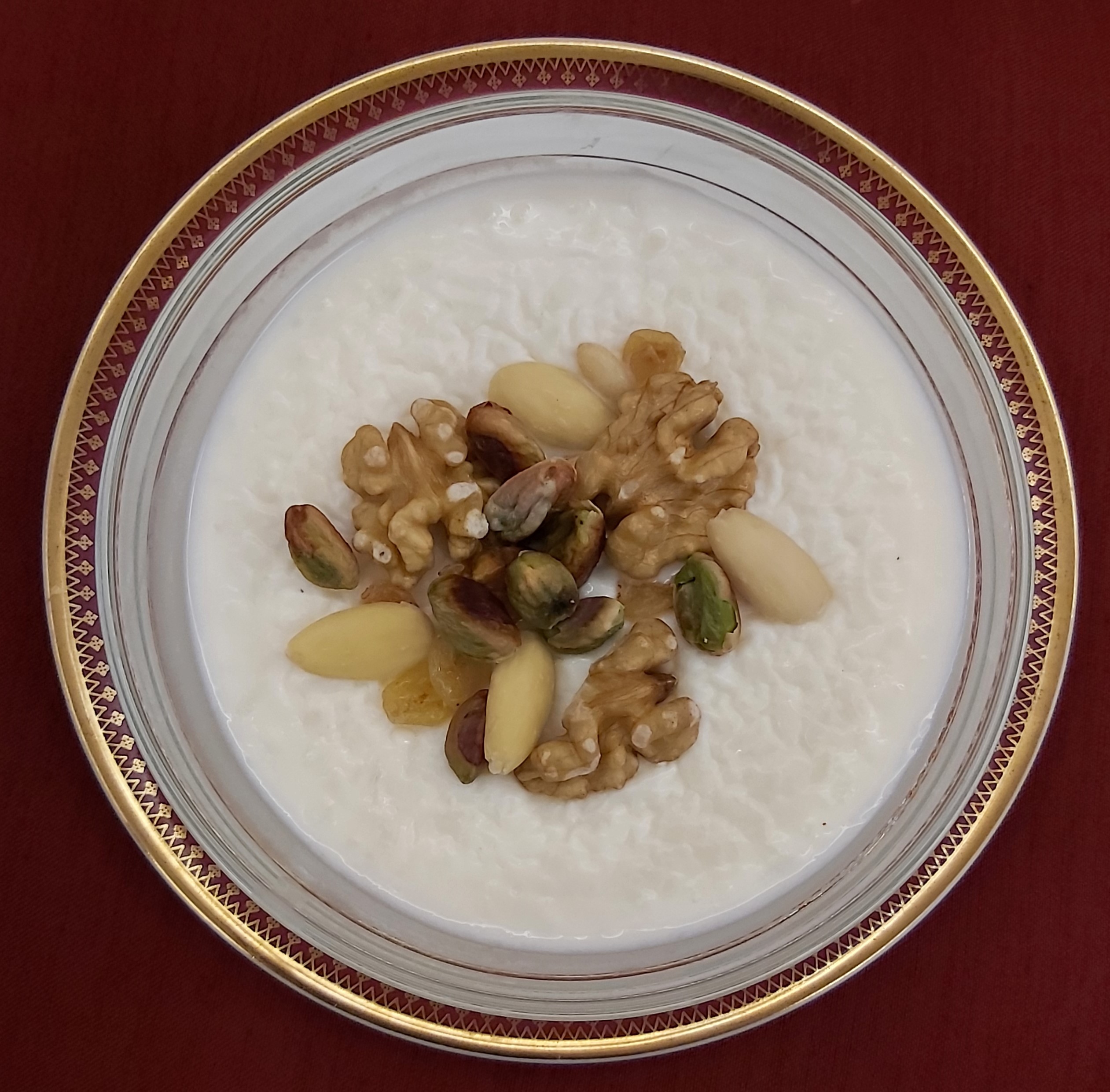
RizbilHaleeb – Rice and Milk pudding (Lebanese recipe)

Rice and Milk with nuts

The following family recipe is a delicious and easy method to prepare rice and milk pudding (Riz bil Haleeb).

Ingredients:

Rice: one cup of approximately 200 g. For one cup, add 4 cups of water.

Milk: 6 cups (200 ml per cup). If using powdered milk, use instructions as directed by the manufacturer to make 6 cups of milk.

Sugar: 200 g. The amount could be increased to taste.

Corn starch: 3 tablespoons.

Orange Blossom water: 2 teaspoons.

Rose Water: 2 teaspoons.

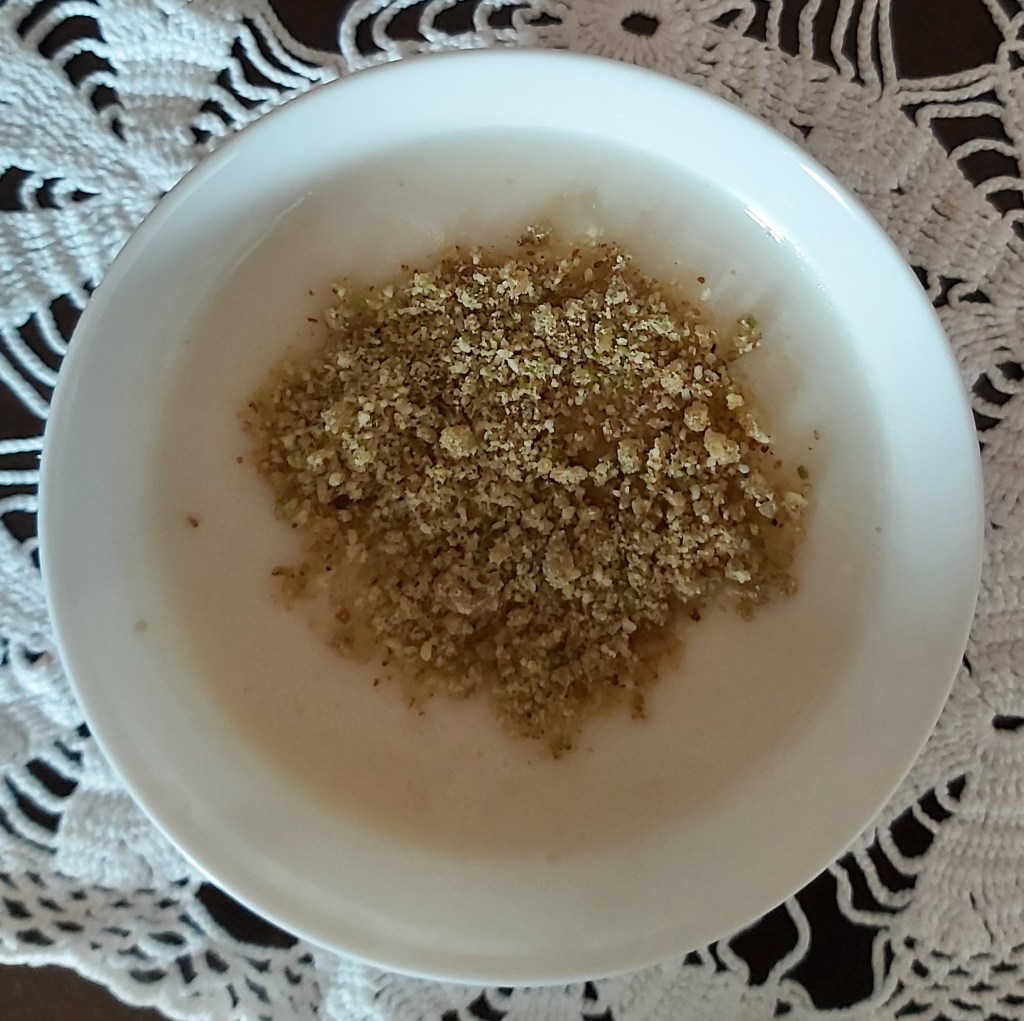
Mastic/Miskeh (resin): 4 small pieces if available. A piece is about the size of a lentil. Grind the pieces so they become powder.

For decoration when serving: Ground pistachios, walnuts, raisins, and/or almonds.

A pinch of cinnamon if desirable.

Method

  • Cook the rice separately until it is cooked.
  • Place the milk in a deep pot on the stovetop on medium heat and keep stirring with a long handled wooden spoon. The milk can be fresh or constituted from powdered milk.  
  • When the milk gets warm, add the cooked rice little by little while stirring continuously. We don’t have to use all the rice if we like a light consistency.
  • Add the sugar and keep stirring until the rice, milk, and sugar become homogeneous.
  • Add the corn starch mixture: To make the corn starch mixture, take a small quantity of warm milk in a cup and add the starch bit by bit while mixing until there is a smooth paste. Add the corn starch mixture to the milk, rice, and sugar while stirring. The corn starch might not all be needed. If all the rice is used, maybe there is no need to use all the starch. Otherwise, the mixture gets gooey or thickens too much.
  • Keep stirring until the milk, sugar, and rice start boiling.
  • After 5 minutes of stirring the boiling content, we add the orange water blossom, rose water, and mastic pieces.
  • Keep stirring and turn off the stove after one minute.

Pour the pudding in bowls and give it time to rest.

The pudding is served cold or warm with pistachios or dried nuts. It is kept in the fridge. The nuts are added before serving.

Some like to add a pinch of cinnamon.

Enjoy!

Back to GLOBAL FOOD page

Other recipes: Zaatar Mankoushe , Lentil Soup , AND Mujadara

HOME

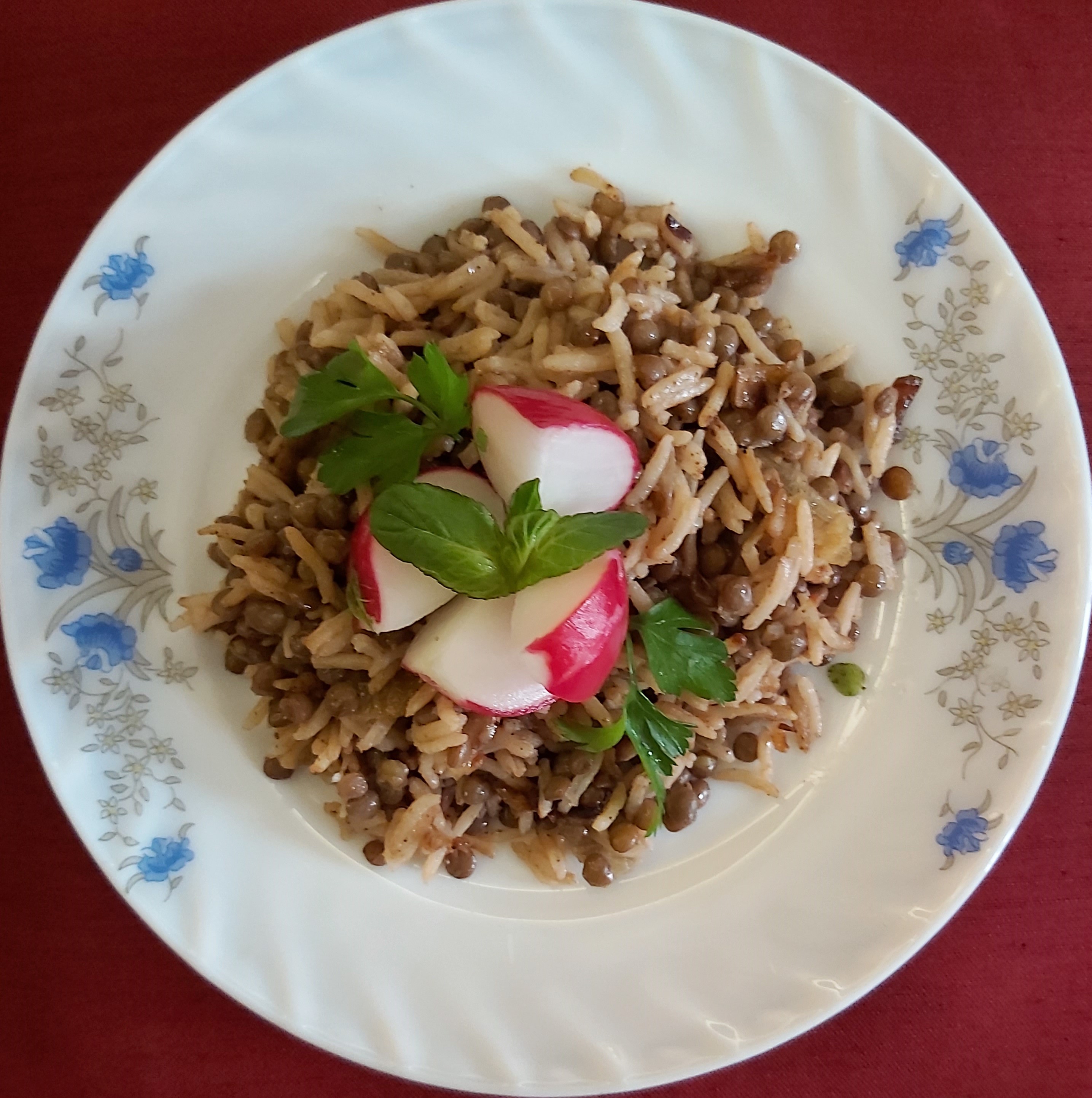
Mujadara – Lentils and Rice (Lebanese recipe)

Picture of Mujadara

The following family recipe is a delicious and easy method for Mujadara/Mojaddara, which is a combination of lentils, rice, and onions.

Ingredients:

1 Cup red/brown lentils

Half or ¾ cup rice

Three medium onions

Seven spice mix (This mix is common in stores that sell Lebanese food or Middle Eastern products. The Lebanese seven spice mix can change from a store to another. In general, it is a mix of black pepper, cumin, paprika, coriander, clove, nutmeg, and cinnamon. If not available, it is fine).

Salt

Cumin

Cinnamon

Vegetable oil for the onions

Olive oil

Method

Start the steps at the same time:

  • Cut three medium onions into pieces and fry in a little bit of vegetable oil and salt.
  • Cook the rice and lentils each in a separate pan. Use three times amount of water.

The rice will cook faster than the lentils. Take the rice once cooked and separate the water from the rice.

Meanwhile, the onions should be frying. Once they start to become golden, add more oil and keep mixing the onions so they don’t burn at the bottom. They should get golden-looking at the same time.

Once the lentils are almost ready, leave a bit of water in the pan and add the rice so they cook on low heat together for couple minutes.

Meanwhile, the onions should be all golden looking. Pour them over the rice and lentils. Add seven spices, cumin, and cinnamon. Small quantities (1/4 of a teaspoon) are added and can be increased to taste.

Add salt to taste.

Add three spoons of olive oil.

Mix the ingredients, cover, and simmer for three minutes, and then turn off the stove.

Cover the pan with a towel and let the flavors mix together for another ten minutes to give time for the lentils to cook. If in a hurry, just make sure the lentils are cooked prior to mixing them with rice and later onions.

Black pepper, salt, and hot spices can be added to taste.

Serve with bread, olives, salad, green onions, parsley, mint, and/or radish.

The dish also tastes good with yogurt.

It can be served hot or cold.

Enjoy!

Back to GLOBAL FOOD page

Other recipes: Zaatar Mankoushe AND Lentil Soup

HOME

Lentil Soup (Lebanese recipe)

Lentil soup with parsley

The following family recipe is the easiest and lightest lentil soup.

The steps are:

  1. Heat 1 cup split red lentils and 4 to 5 cups water.
  2. When they begin to boil, remove the thin layer that forms on the top.
  3. Chop and add 3 medium onions and 2 medium potatoes.
  4. Add 3 to 5 peeled garlic cloves to taste.
  5. Leave on reduced heat until the potatoes are cooked. This should take 10 to 12 minutes.
  6. When they are cooked, blend them to the thickness of yogurt.
  7. Add 1/2 tsp salt and ¼ tsp cinnamon.
  8. Pour the soup back in the saucepan. Boil together for 3 to 4 minutes on reduced heat.

Turn off the stove. The soup is ready!

To serve:

  • Add olive oil, lemon juice, and a sprinkle of ground cumin to taste.
  • Add chopped parsley to taste.
  • Bread (preferably pita bread) can be toasted and spread in small pieces on top of the soup.

Enjoy!

Back to GLOBAL FOOD page


HOME